The Making of LambdaSpeak for the Amstrad CPC
From Humble Beginnings as an Arduino Project to a Multi-Purpose CPC Expansion Board. My article of June 2022, also on Github. The projects themselves are on the hardware projects page.
This is an article that was invited by the editor of the "Amstrad CPC ACUC (Amstrad CPC User Club Magazine)", Dr.CPC. Unfortunately, this fanzine no longer seems to exist, and the article never got published, so I thought I'd put it up here. Enjoy!
My (LambdaMikel's) fascination with speech synthesis started in the early 80s, and was likely ignited and then nourished by movies such as "Colossus - The Forbin Project", "2001", and "Wargames".
When I got my Schneider CPC 464 with CTM 640 Color Monitor for my confirmation in April 1985, the first hardware extension that I acquired in July 1985 was the freshly released DK'tronics speech synthesizer, containing the infamous SP0256-AL2 speech chip used in so many speech synths of that time. Soon it gave the "Eliza" program from David H. Ahl's "More BASIC Computer Games" a voice, and it could even speak German (albeit with a strong American accent)!
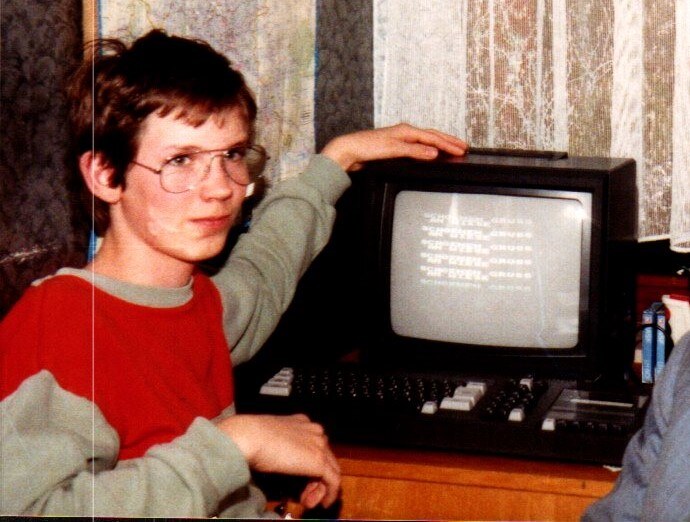
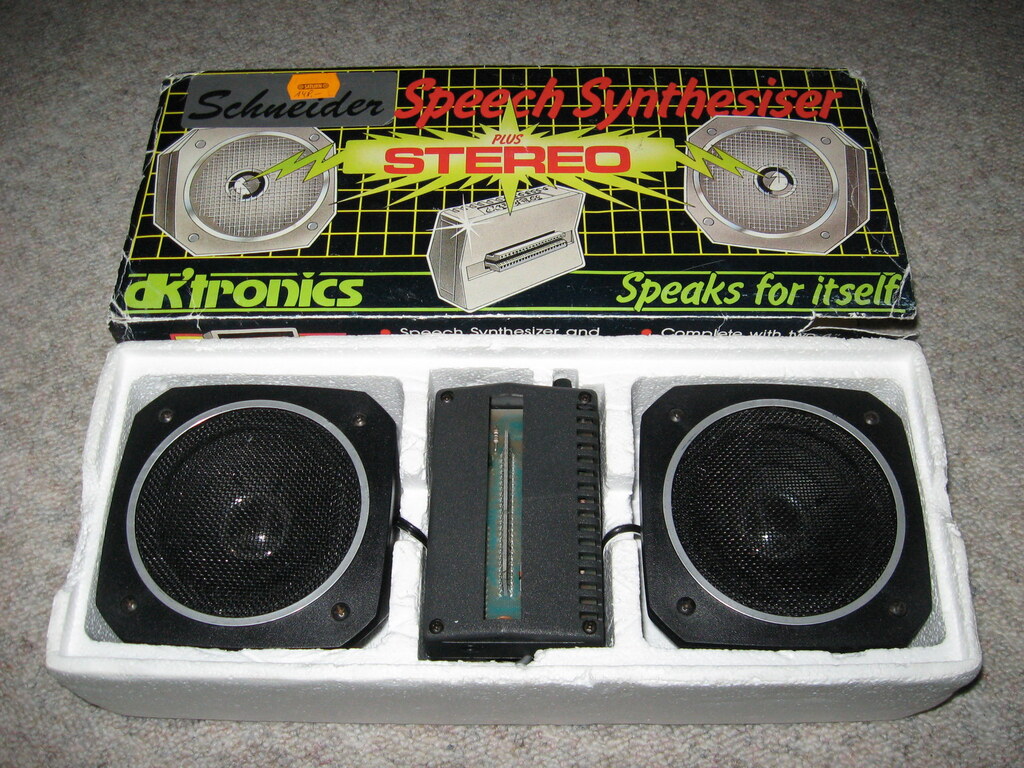
Whereas the DK'tronics was certainly a cherished item, I was nevertheless a bit disappointed by the SP0256-AL2's limited capabilities. The speech quality was lacking and too monotone and robotic for my taste, and, of course, no match for HAL 9000... but even in comparison to the computer voice in "Wargames" (I later learned that the Wargames computer speech synth wasn't real either). Also, it certainly didn't help the SP0256-AL2's performance that DK'tronics made a serious design simplification - the SP0 requires a proper 3.12 MHz clock and hence an extra crystal for proper operation, but to save some pennies, DK'tronics decided to omit the crystal and used the CPC's 4 MHz clock instead. This resulted in a speech pitch and allophone speak rate that was 22% too high, severely damaging voice clarity. Later, Amstrad would release the SSA-1 using the same chip, but with the extra crystal. In comparison, the SSA-1 sounds much better than the DK'tronics indeed. I wondered if maybe one day I could design a more natural sounding voice synthesizer for the CPC that sounded as good as HAL 9000! One day...
Fast forward 30 years (in 2016), I started tinkering with Arduinos, and came across the Emic-2 speech synthesizer module in Palo Alto's Fry's Electronics store. Its quality of speech blew me away - finally, natural sounding speech from a compact, affordable little unit! I realized that this unit was the key to realizing my dream from the 80s. I learned that the Emic-2 was running the legendary DECtalk speech synthesizer software, and that it could even sing, just like HAL 9000!
And, sure enough, in May 2017, I released the first version of LambdaSpeak using the Emic-2. Emic-2 was controlled over a serial interface from an Atmega 328p (Arduino Uno R3) microcontroller chip (as a so-called "shrimped" Arduino design). In addition, a bunch of glue logic was used, featuring two GAL 16V8 for address decoding, some combinational logic (74LSxxx gates) for databus handling, etc. Later versions also included a loudspeaker and were designed to not block the display of my beloved DDI-3 HxC disc emulator interface connected to my CPC 464. I was just having fun.
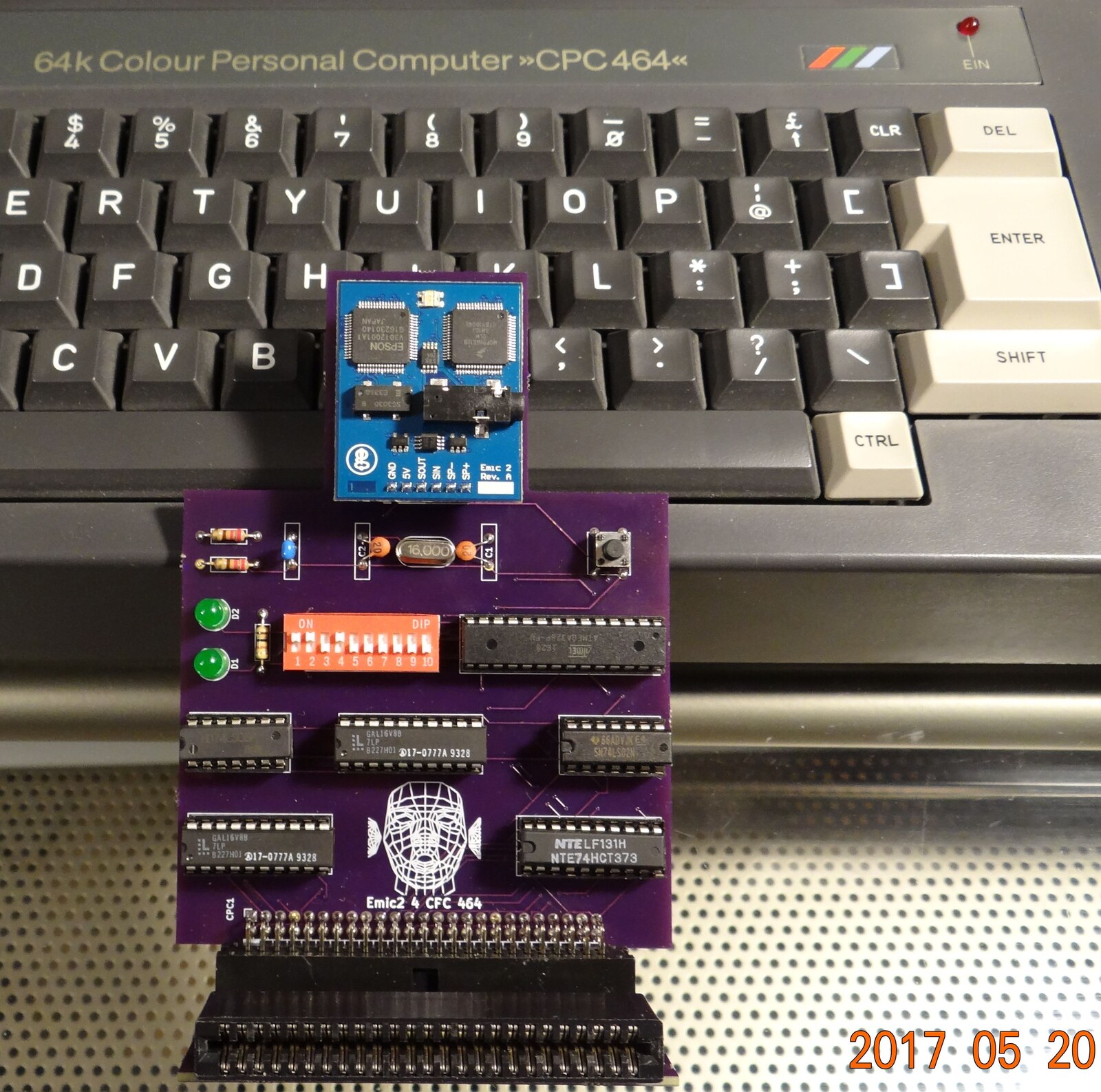
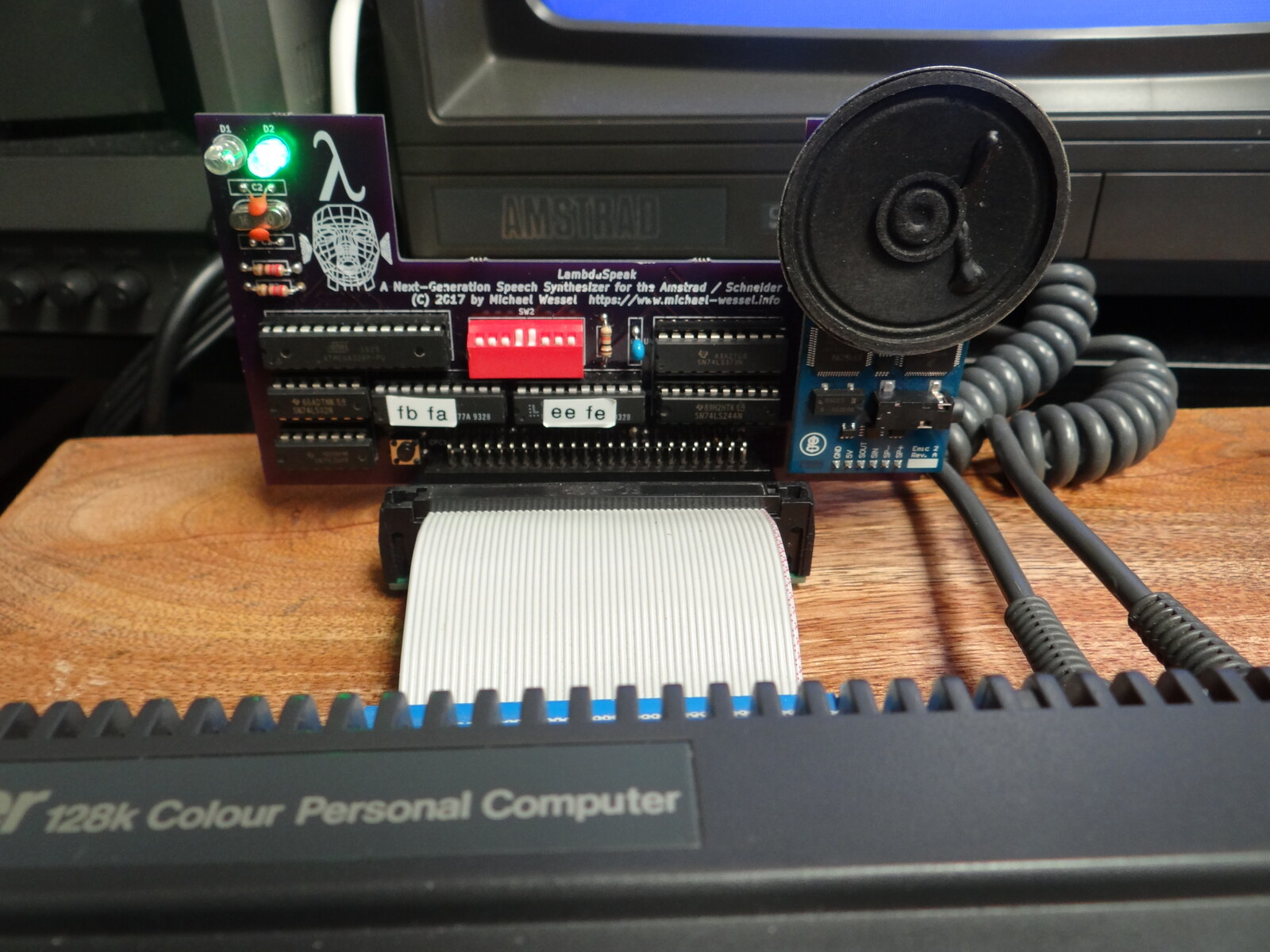
However, Emic-2 was (too) pricey, my first designs were too clunky, and so I was looking for an alternative. Realizing that the Emic-2 was centered around the Epson S1V30120 DSP, I found a module which was only half the price, and which became the heart of all future LambdaSpeak designs: the Text2Speech "Click!" board from MikroElektronika.
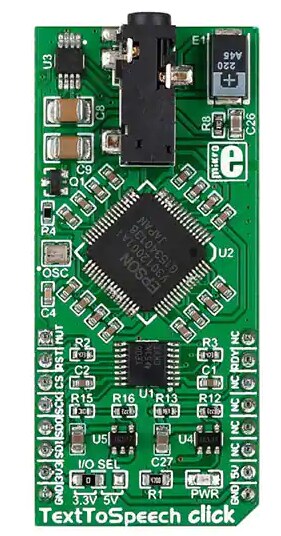
In order to use it, I had to switch to a more powerful microcontroller, for which I chose the Atmega 644 with 64 KB of program memory. The 32 KB found in the ATmega 328p were no longer sufficient to store the S1V30120 firmware image which includes the DECtalk software (the Emic-2 was hosting this firmware in its own microcontroller).
Whereas the original focus of LambdaSpeak was to provide natural sounding speech, it dawned on me that it would be nice if it could also emulate the original DK'tronics and SSA-1 speech synthesizers so that existing speech synth software (especially games with speech) would run with it. I hence worked out a mapping from SP0256-AL2 "allophones" to DECtalk phonemes and learned how to emulate the SP0 chip signals so that existing speech software would detect an SSA-1 or DK'tronics speech synth when in fact there was a LambdaSpeak. Finally, in February 2018, the SP0 emulation was working well enough so that existing SSA-1 and DK'tronics speech software would run with LambdaSpeak. LambdaSpeak 1.5 was born, and I started to sell a few units to like-minded CPC enthusiasts.
These first LambdaSpeak customers started to make feature requests! For example, Zhulien from the CPC Wiki EU Forum suggested the "Amdrum emulation mode". This mode turned LambdaSpeak into a high-quality PCM 8bit sample player, and the original Amdrum drum computer software sounds as good with LambdaSpeak as with the original Amdrum hardware (if not better). Later, TFM ported Prodatron's Digitracker (an 8Bit PCM Sound Tracker meant for the DigiBlaster) to use the Amdrum mode as well.
At some point, Bryce from the CPC Wiki EU Forum also provided some guidance and ideas; for example, he reviewed one of my earlier designs and suggested some improvements. He also recommended replacing the two GALs and remaining 74LSxxx glue logic by a single Xilinx CPLD (Complex Programmable Logic Device, similar to an FPGA) to reduce the chip count and hence costs. Thanks to Bryce, I started to learn Verilog and familiarized myself with CPLDs. A CPLD was used for LambdaSpeak III (see below) and for some of my future projects (e.g., Speak&SID for the CPC).
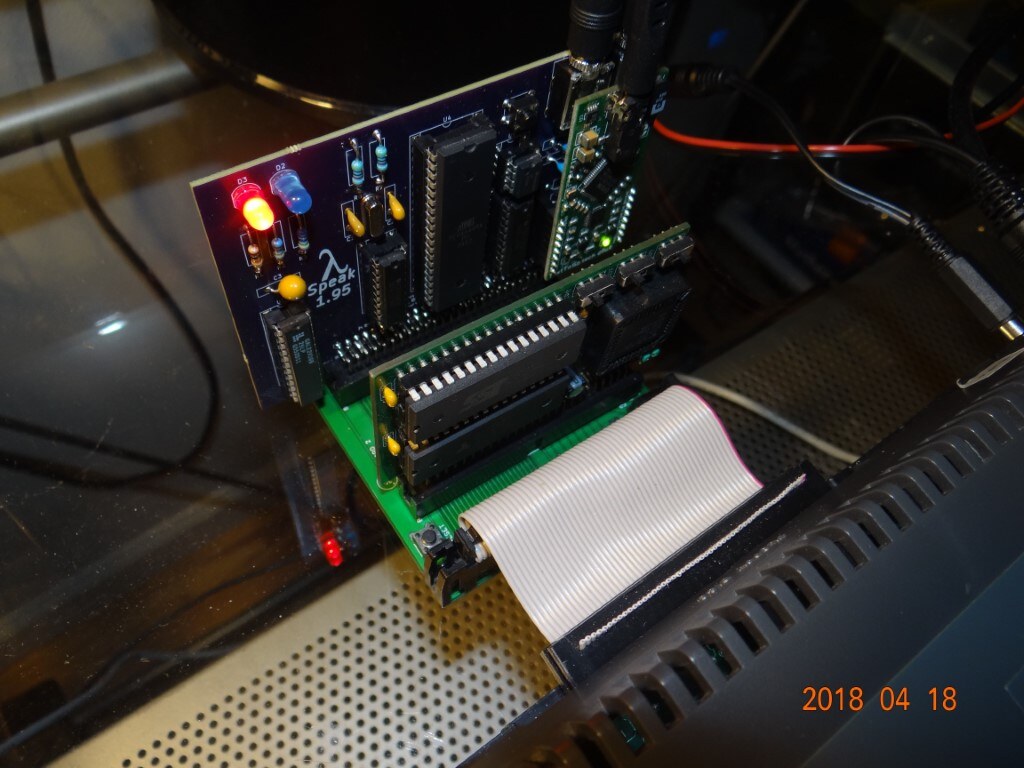
TFM of FutureSoft joined the LambdaSpeak development team in early 2018 - whereas early versions of LambdaSpeak only came with a set of primitive BASIC demo programs and the original SSA-1 and DK'tronics software, TFM now started to develop a full-fledged and feature-complete expansion ROM containing dozens of RSX commands, truly unleashing its full potential! After a number of revisions, LambdaSpeak 1.95 was the first feature-complete and stable version of which about 20 units were sold in 2018, and which now came with TFM's sophisticated RSX software. Here is a picture of LambdaSpeak 1.95 with TFM's RSX ROM hosted by ToTO's Xmem.
Whilst selling LambdaSpeak 1.95, I completely redesigned the hardware and replaced the combinational logic with a single powerful Xilinx XC9572 PLCC84 CPLD. More and more features were added, eventually culminating in the release of LambdaSpeak III in March 2019. A highlight of LambdaSpeak III was a socket for the original SP0256-AL2, as a second speech chip option! With the original SSA-1 / DK'tronics speech chip on board, LambdaSpeak III is also a modern re-implementation of these classic speech synths, not only an emulation. With an SP0256-AL2 on board it sounds exactly like the originals, and it also has the proper 3.12 MHz crystal. However, the SP0256-AL2 is optional and can be difficult to source, so you will still get the DECtalk-based SP0 emulation without it.
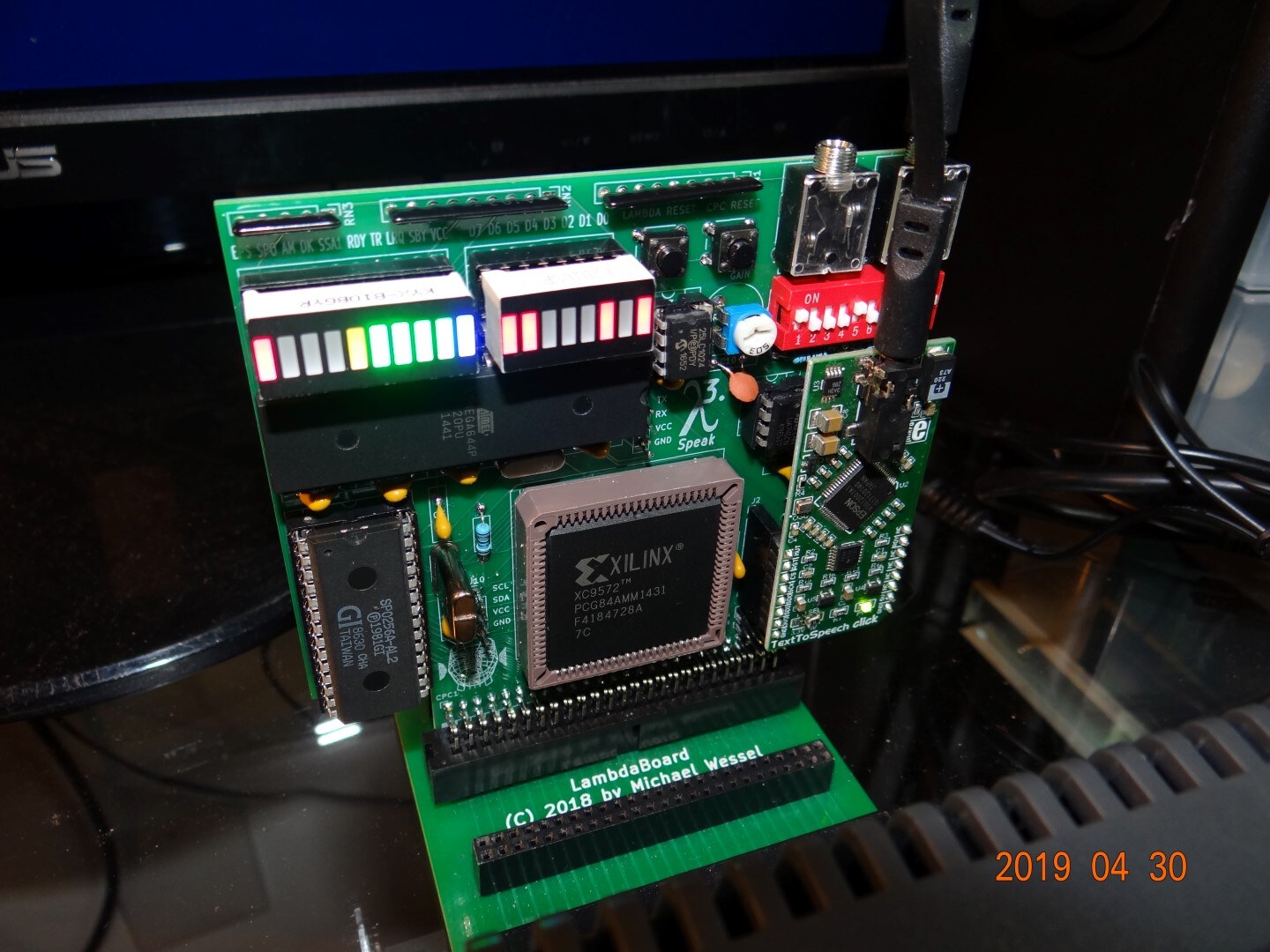
Eventually, the final versions of LambdaSpeak III featured:
- natural sounding DECtalk speech synthesis that puts HAL 9000 to shame, supporting English and Castilian Spanish;
- the SP0256-AL2 emulation,
- an optional SP0256-AL2 as a second speech chip option - if present, LambdaSpeak III is also an SSA-1 and DK'tronics re-implementation that sounds like the originals;
- the Amdrum PCM sample playing mode;
- 128 KB of (SPI) EEPROM providing for non-volatile data storage - its main purpose is to act as PCM sample memory for the
- 8bit high-quality PCM sample player mode, realizing 4-channel PCM sound of unheard quality on the CPC; this mode differs from the Amdrum PCM mode in that the CPC does not have to stream the PCM sample data - instead, the data is coming from the EEPROM and it can be played back autonomously by LambdaSpeak without CPC involvement, hence greatly reducing CPU load;
- a general purpose serial interface that can be used to control, for example, a serial MP3 player or a MIDI interface breakout board; and finally,
- a battery backed-up real-time clock with temperature sensor (a DS3231 via I2C protocol).
Unfortunately, LambdaSpeak III turned out to be too pricey for broad customer acceptance (with an SP0256-AL2 chip, it was in the 120 Euro range!), and sales had been slow. Given both TFM's and LambdaMikel's huge time and financial investment in developing it, TFM suggested in November 2020 to improve the situation by bringing "LambdaSpeak to the masses, not the classes" - the idea to develop a much more affordable "cost-down" version was born. Hence, the SP0256-AL2 option as well as the EEPROM and extended PCM sample playing modes were dropped, and the MP3 and RTC modules were added by default as they were received more favorably by customers. LambdaSpeak "FutureSoft Edition", or LFS for short, was born!
The slightly reduced capabilities of LFS made a massively cost-reduced hardware possible - the expensive (and increasingly difficult to source) Xilinx CPLD was replaced by a single 22V10 GAL for address decoding, accompanied by the same ATmega 644 microcontroller, and a 74LS374 flip flop in tandem with a 74LS244 line driver for CPC databus management. LambdaMikel designed the LFS hardware over the Thanksgiving weekend 2020, and delivered a first prototype to TFM in December 2020.
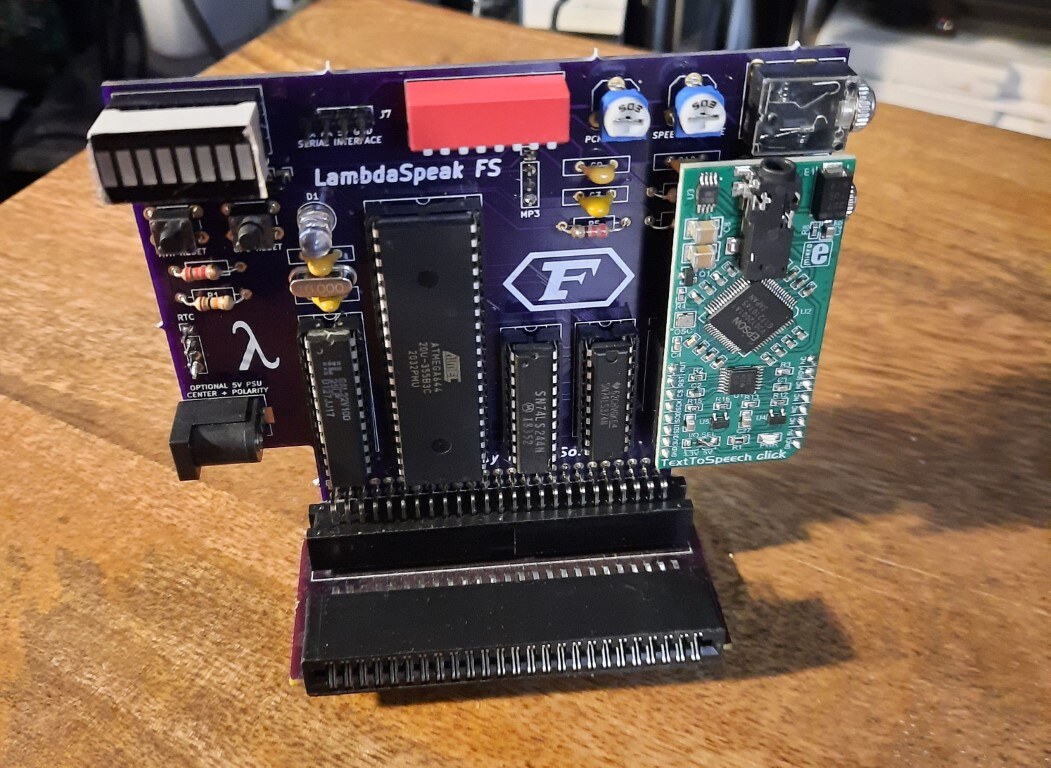
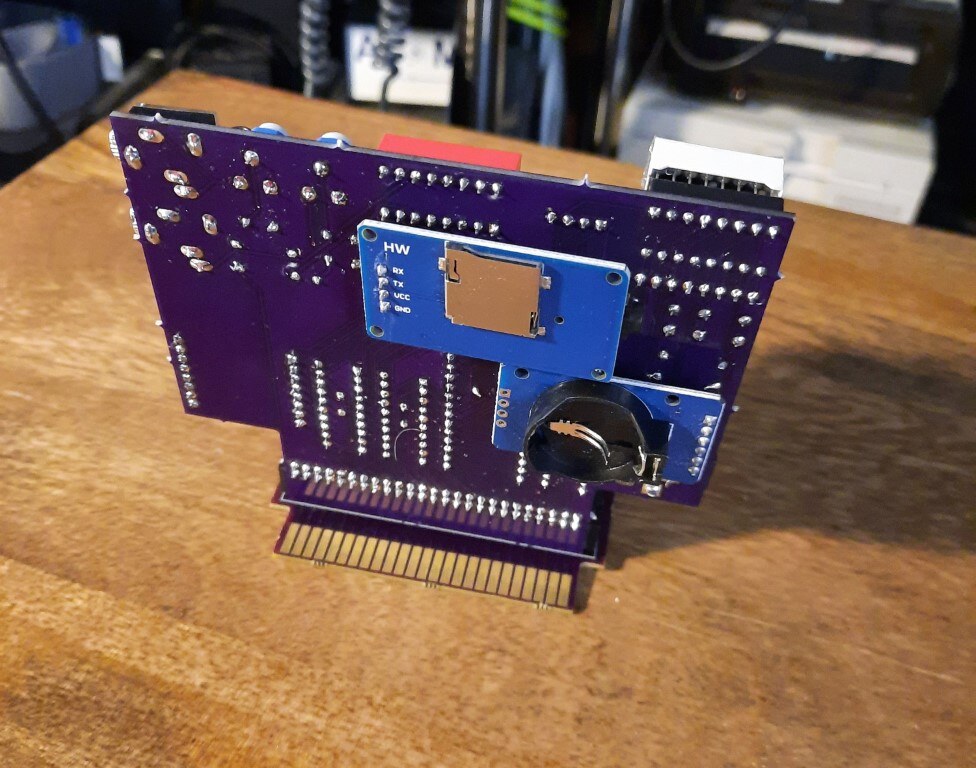
TFM started refactoring the LS III ROM software for LFS. Finally, the first batch of 10 LFS was shipped to TFM for distribution in January 2021. Eventually, TFM took on production of further units, continued to develop the ROM software, provided customer support, shipping, and spread the word in the CPC Community.
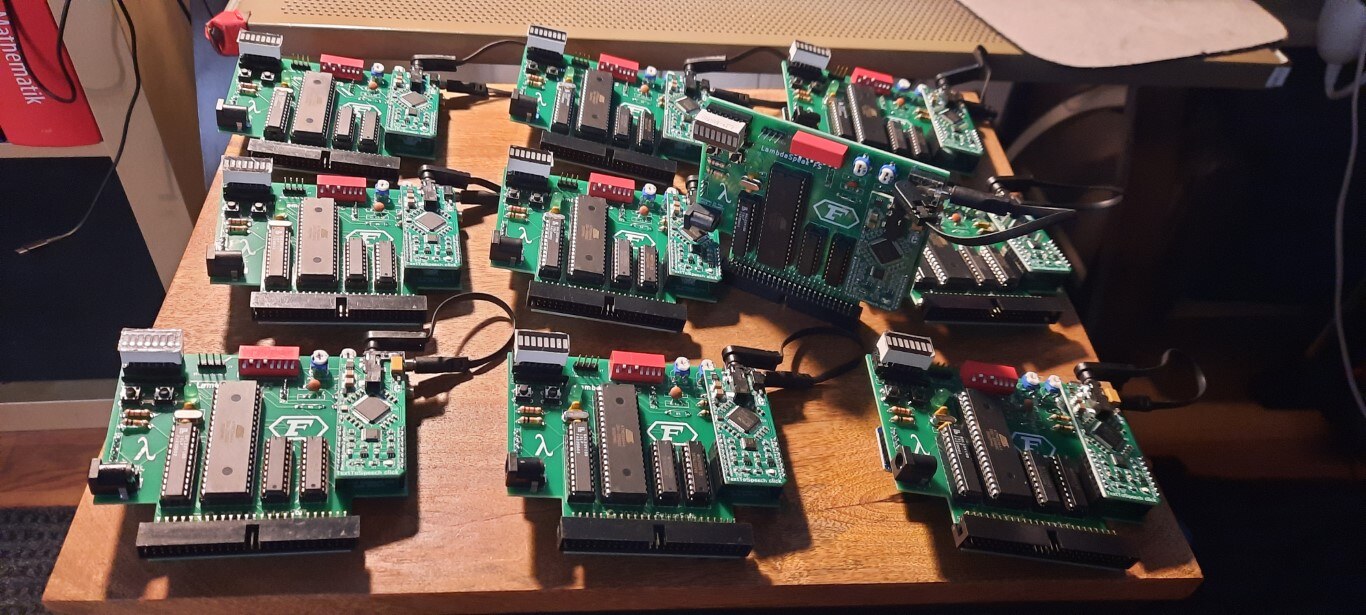
At the time of this writing, TFM is the sole point of contact for all LFS-related issues, including sales. So, join the future of speech synthesis, and give your CPC a voice - get a LambdaSpeak FS from TFM! And be sure to read TFM's LambdaSpeak RSX ROM software description in this issue as well. You can find a lot of information about LambdaSpeak on GitHub - everything is OpenSource, including the hardware & software, demo programs and videos, etc.
Sincerely yours,
LambdaMikel, June 20th, 2022, Palo Alto, CA, USA