About These Pages - A Short History
Claude Code-assisted
These pages are not written in HTML. They are the output of a Common Lisp program - a few dozen macros and a small markup language of my own - that I wrote for this homepage in 2008, based on an idea I first used in 1995. In October 2026 the same macros, unchanged, were picked up again after nine years of rest. This is the story.
|
1995
|
|
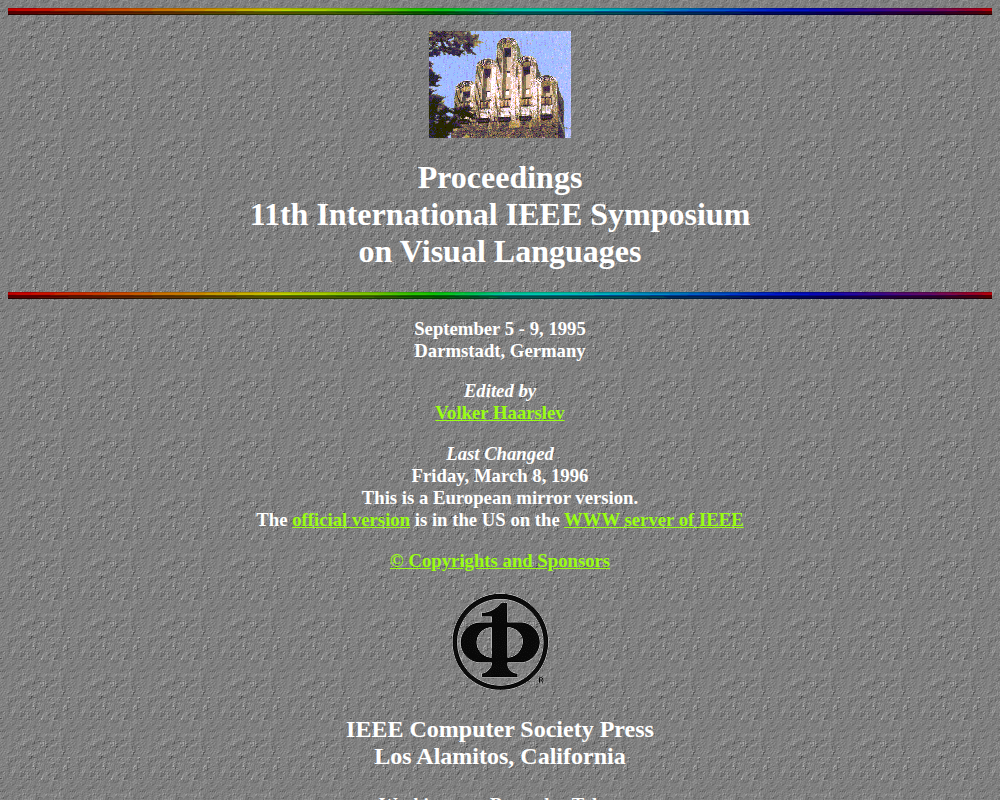
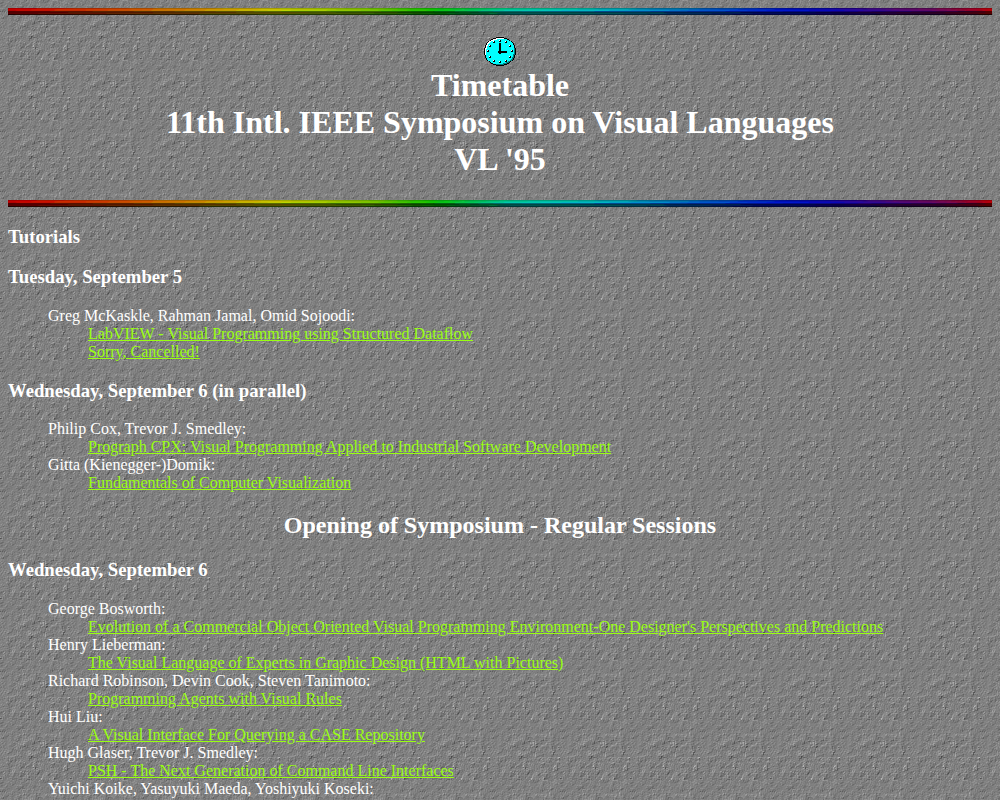
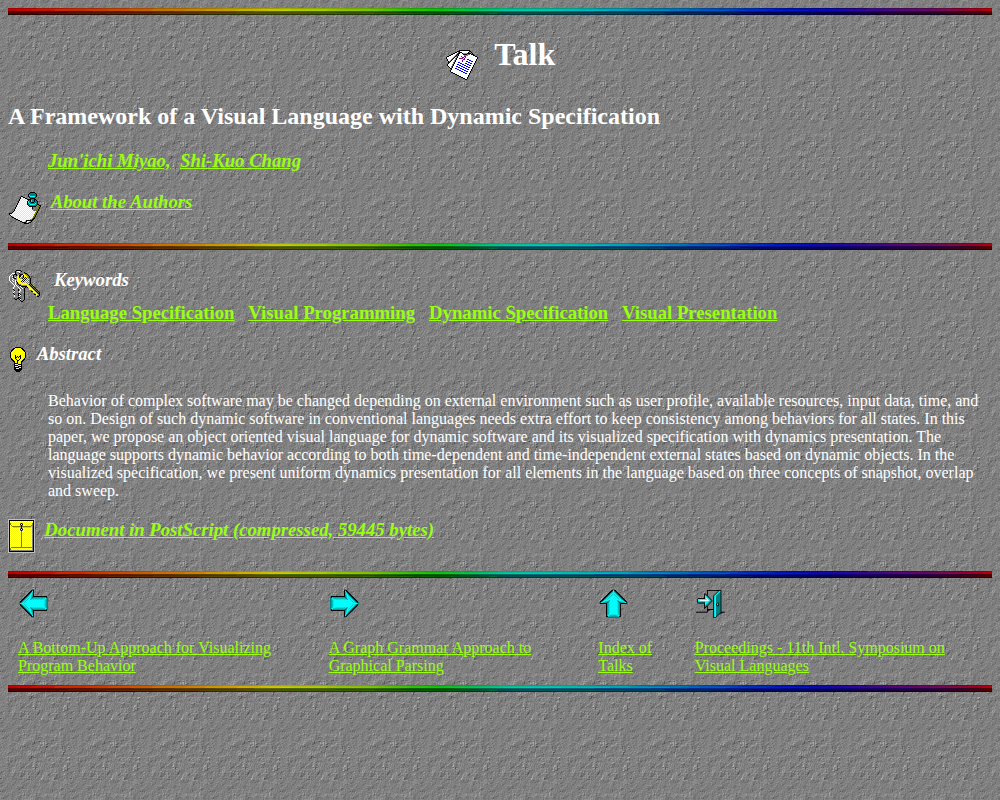
The first HTML macros: the VL'95 web site.
|
|
As a student in Hamburg I had a paid job building the web site of the 11th IEEE Symposium on Visual Languages (VL'95, Darmstadt, September 1995) for Volker Haarslev, who edited the proceedings. Writing a page per paper by hand seemed like the wrong idea, so I wrote Common Lisp macros that generated the HTML from a description of the programme. Every page carried the line GENERATOR: "Throwaway macros in Common LISP, written by Michael Wessel. Pages verified with Hot Metal 2.0" in its header. The throwaway macros were not thrown away, as it turned out. The original site is offline, but it survives in the
Internet Archive.
The site was generated on a Sun SPARCstation 10 or IPX, with Allegro Common Lisp (probably version 4.2 - version 5 only came out in 1998). Compiling all those macros took about fifteen minutes, with lots of swapping. Thirty-one years later the macros had the same effect on SBCL: the page functions are so large that they exhaust its compiler, so today the generator runs interpreted.
Putting it in perspective: this was early. At MIT, John Mallery had just written CL-HTTP (1994), a web server in Common Lisp that generated HTML with Lisp macros - but its pages were made on request. Paul Graham's Viaweb, also from 1995, generated its online stores from Lisp, too. Franz followed with AllegroServe and its HTML macros around 2000. Generating a whole site in advance, as static files, is what static site generators became known for only much later - Jekyll, for example, appeared in 2008, the same year as the generator of these pages.
|
|
|
until 2008
|
|
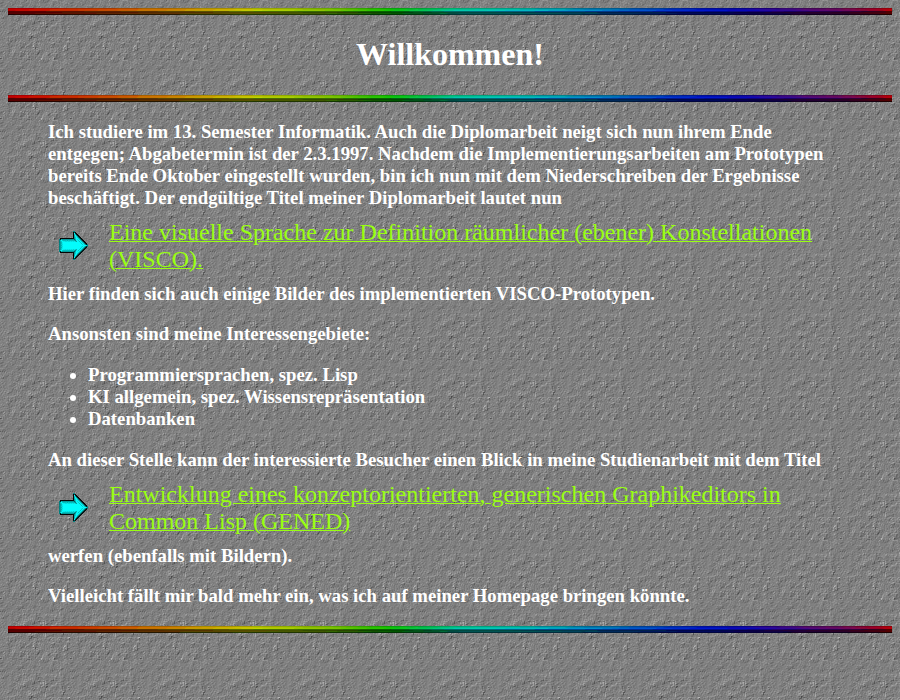
A homepage written by hand.
|
|
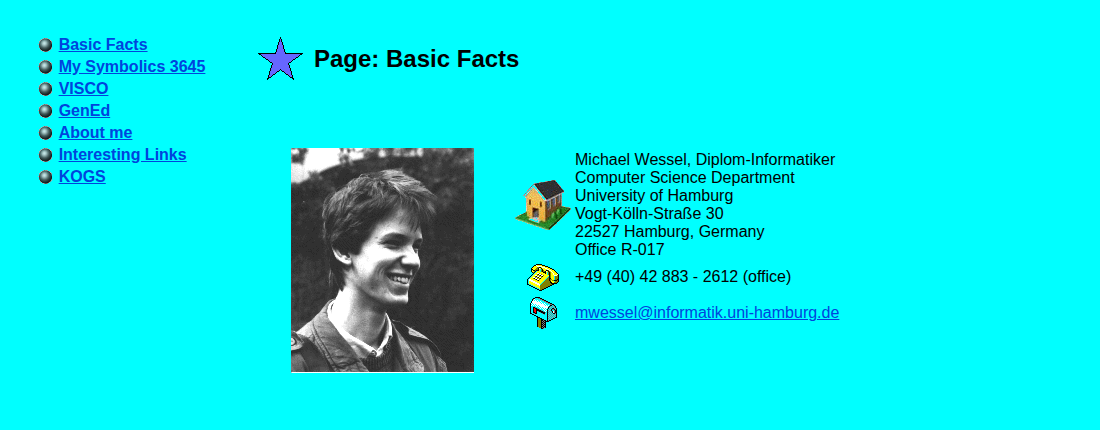
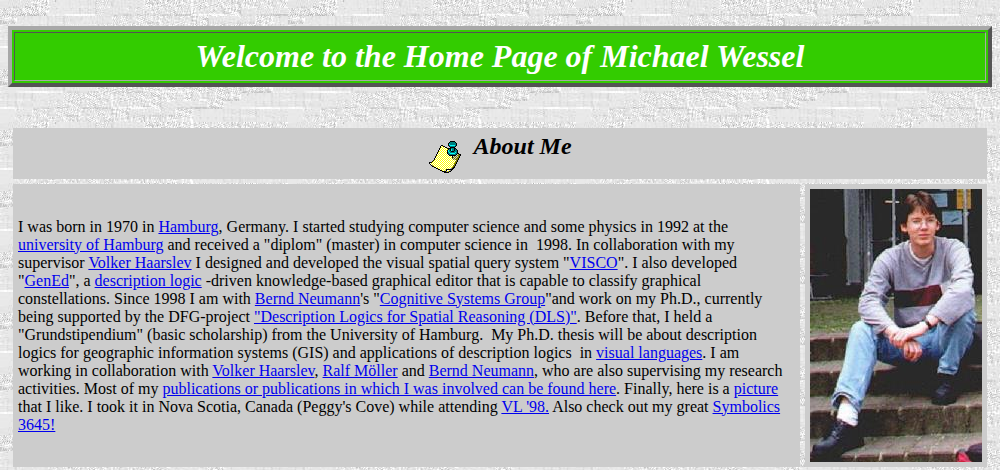
My first homepage lived on the server of the Cognitive Systems Group at the University of Hamburg (kogs-www.informatik.uni-hamburg.de). The earliest version, written in German while I was finishing my diploma thesis, simply reused the look of the VL'95 pages. From 1999 on I made it with Netscape Composer - bright cyan, with a rotating star - and added pages about my Symbolics 3645. Around 2001 came a more sober English version, made with another HTML editor. In 2004 the homepage moved with me to the Hamburg University of Technology. A hand-written page from that time carries the note "Last Changed: May 2008" - it was the last one of its kind. The old pages are in the
Internet Archive,
too.
And a backup of the real thing turned up as well: my complete homepage as it was
from 2001 to 2004,
with
the cyan version of 1999
inside (password required).
|
|
|
2008
|
|
The Common Lisp macros for this homepage.
|
|
In May and June 2008, a few weeks after my doctoral defense, I picked up the 1995 idea again and wrote the generator that still produces these pages. The oldest generated pages - DLMAPS, VISCO and GenEd, which I mainly added to have complex test content - are dated 12 June 2008, and the
blog
starts in April 2008. In December 2008 the generator got its biggest job,
25 Years of Home Computing.
|
|
|
2009
|
|
michael-wessel.info.
|
|
The domain was registered on 20 March 2009. An older dynamic DNS address, michaelwessel.homedns.org, survives as a comment in the sources.
|
|
|
2013
|
|
A Raspberry Pi as the web server.
|
|
Since September 2013 the site has been hosted on a Raspberry Pi at home - first an early model, later a Pi 3, today a Pi 4.
|
|
|
2017
|
|
The last update by hand.
|
|
The generator had grown to about 7,500 lines of Common Lisp, running in LispWorks. I last touched it in September 2017. After that, only the front page was edited, directly on the server, and the pages slowly went out of date.
|
|
|
2026
|
|
Claude Code takes over.
Claude Code-assisted
|
|
In October 2026 I gave the old sources to Claude Code, Anthropic's coding assistant, and asked it to revive them. It ported the generator from LispWorks to SBCL with a small compatibility layer, regenerated the site, and compared the result with what was on the server. Then, working with me, it refreshed the whole site with the same macros: a new front page, the research, thesis, hardware and software pages, a publication list with local copies of the papers, new picture galleries, relative links, and repairs to the server.
|
|
How the generator grew in 2026
In September 2017 the generator had 7,548 lines; in October 2026 it has about 10,500, and it writes 31 pages with more than a hundred project cards and over a hundred publication entries. The core - the HTML macros and the markup language of 2008 - was not changed; everything new was built on top of it:
-
Running it again.
A port from LispWorks to SBCL, with the few implementation-specific parts (shell commands, directory listings, environment variables) behind a small compatibility layer; it still loads in LispWorks. A script regenerates the site, another one shows what changed and transfers it to the Raspberry Pi, and a third one backs up the server every week.
-
Pages that work anywhere.
All links are relative now, so the same files work on the server and straight from the disk. The "Changed:" date of a page is computed: a page keeps its date as long as its content stays the same, and a checksum per page decides. A layout for phones, and site icons drawn from my old logo.
-
Project cards.
The hardware, software and thesis pages are lists of cards. A card is a short list of properties - title, date, text, picture, links, press coverage, extra pictures and magazine scans - and one function lays them all out, with a large picture behind the thumbnail and the YouTube playlists in the section headings. Whether Claude Code was involved is a single property of a card, which shows as a label:
Claude Code-assisted when it wrote the code, Extended by Claude Code when it extended mine.
-
Publications.
Every entry is a small record with local copies of the papers and slides and the video of the talk, where there is one.
-
Links that stay alive.
Every external link is recorded with its page while the pages are written. On request, the generator then checks them all - one curl process, a second slow pass for the sites that throttle - and writes a report of dead, moved and unreachable links, which Claude Code then repairs. The first run, in October 2026, found two dead links and eleven moved ones.
The previous version of these pages is preserved:
My old homepage.
What it looks like
A page is a Lisp function. This is the complete source of the
Symbolics gallery page;
the string starting with @autogal is the markup language, which here asks for a thumbnail gallery of a directory of pictures, four to a row:
(defun symbolics ()
  (with-navi (+hp+)
    (h3 () (c "My Symbolics 3645 Lisp Machine"))
    (p () (c "I once owned a Symbolics 3645, from 1999 to 2003!
              Sadly, the machine is no longer with me."))
    (render-content1
      "@autogal{downloads/symbolics/original/}{}{4}{}" :html)))
What I take from it
The macros I wrote in 2008 still do their job in 2026, on a different Lisp implementation, on a different operating system, and in the hands of a different author. Common Lisp code does not rot: the language standard has not changed since 1994, so there was nothing to migrate. And the abstractions held up - a page is still described by what it contains, not by its HTML, which is why a new maintainer could add pages, galleries and whole sections without rewriting what was there. Everything new on this site was written with the same stone-age macros.
There is no database behind these pages, and no content management system - and none is needed. The content lives in the Lisp source itself, as lists: a project card, a publication or a blog entry is a few lines of data. The generator turns them into plain HTML files, and the web server does nothing but send files: about 16,000 of them, 335 HTML pages among them. For a site of this size a database would only add work - a query and a page assembled on every visit, a server process to keep running and patched, a dump to back up - and it would make the pages slower, not faster: nothing beats a file that is already there. It is also a matter of security: a database, or a system like WordPress with its plugins, is program code that runs on every visit, behind a login page - and that is where the attacks go, with SQL injection, stolen passwords and one vulnerable plugin after another. Static pages offer none of that: no code runs when a page is requested, there is nothing to log in to and no database to break into. The web server and the operating system still need their updates, but the surface an attacker could aim at is about as small as it gets. A backup is a copy of a directory, and the whole history of the content is in version control, line by line.
This account was compiled by Claude Code from the files of the generator, the dates on the old pages, and my recollections.