AI and Mathematics
Since early 2023 I have been probing the reasoning of AI systems and putting it to work: with a logic puzzle, with the Goldbach conjecture, with knowledge bases for description logic reasoners - and since 2026 in earnest, with an open problem from my own PhD work.
February 2023: ChatGPT and the blocks world
I started with a classic puzzle about reasoning with incomplete information, which I had used in my description logic classes: three blocks are on a table, the leftmost is green, the rightmost is red, and every block is either red or green. Is there a green block next to a red one? Yes - whatever the color of the middle block, by case analysis. The puzzle goes back to Robert C. Moore's AAAI paper of 1982. ChatGPT first said no, then that it could not tell, then agreed after I walked it through the two cases - and then said no again. The dialogue is in my LinkedIn post.
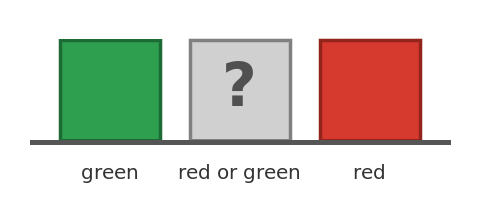
Is there a green block next to a red one?
May 2023: the Goldbach conjecture with ChatGPT
In May 2023 I was among the first to throw a famous open problem at ChatGPT (GPT-3.5): I asked it to help me prove the Goldbach conjecture, with a "stick-breaking" analogy that turns it into a problem about cutting sticks into pieces of prime length. We did not prove it, of course, but the dialogue left me baffled: Proving the Goldbach Conjecture with ChatGPT? (Hackaday.io). I have tried again with every new model since. In March 2026, one of them turned the stick-breaking idea into a seven-page paper (written by an LLM). Still no proof - but compare it with the chat of 2023.
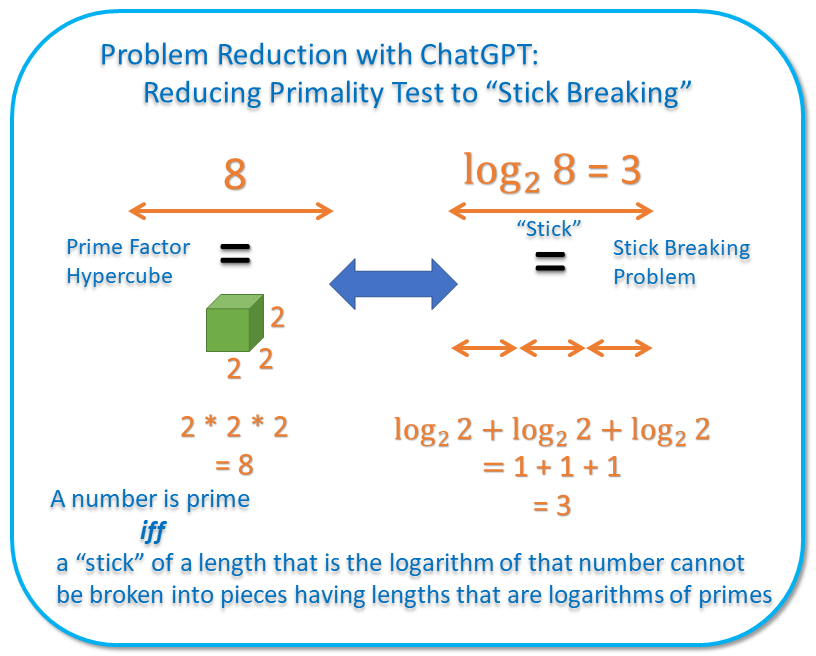
The stick-breaking reduction, from my Hackaday.io project (2023)
January 2025: knowledge bases written by an LLM
LLMs could be a real game changer for the old "knowledge acquisition bottleneck" of knowledge representation. In January 2025 I had ChatGPT turn a few plain English sentences about a family into a knowledge base in KRSS, the classic syntax of description logic systems, and answer a question about it by inference. It made some errors - and that was part of the point: I proposed to load such an LLM-written knowledge base into a description logic reasoner like RacerPro, let it check consistency and coherence, and feed its verdict back to the LLM, so that the LLM corrects itself - an agentic loop of LLM and symbolic reasoner. The chat is in my LinkedIn post.
In March 2026 I worked that way with Claude. In 2014 I had shown how to solve the Wolf-Goat-Cabbage riddle by SAT planning with description logic reasoning. Claude and I tried eight more compact, role-based encodings of it in KRSS and let RacerPro judge each one: most were too slow or subtly wrong, and the last one is correct and reasonably fast. There is a short paper (written with Claude) and a GitHub repository with the knowledge bases and our whole conversation.
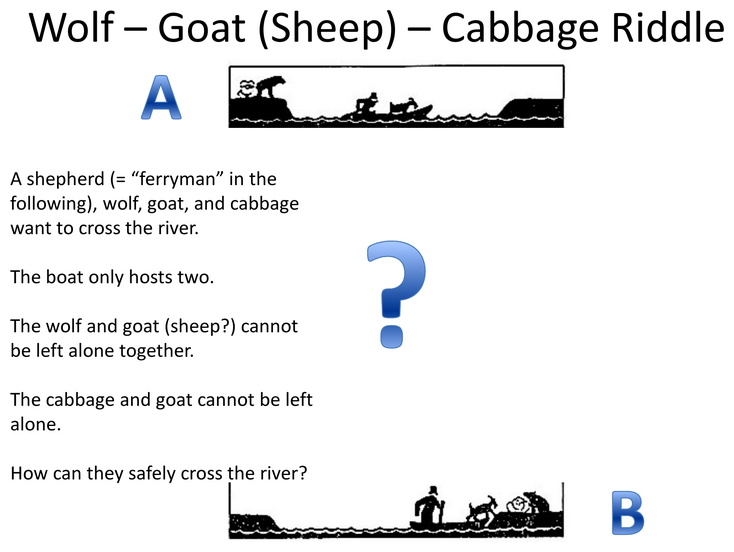
The riddle, from my 2014 slides
Vibe math
Andrej Karpathy coined the term "vibe coding" in February 2025. In April 2025, in a comment on Cassie Kozyrkov's LinkedIn post about it, I suggested "vibe math" for doing mathematics the same way, and pointed to my Goldbach session.
2026: ALCI_RCC5, and a warning that was not heard
Whether concept satisfiability in ALCI_RCC5 - the description logic ALCI with the RCC5 spatial relations as roles - is decidable has been open since I stated the problem in 2002/2003. In February 2026 I started a sustained attack on it with AI assistants (Claude and GPT models): I directed the work, the assistants wrote the proofs, the Lean code and the papers, and every claim had to survive adversarial reviews by other models. Everything, including the dead ends, is in the GitHub repository; the papers are also on my research page.
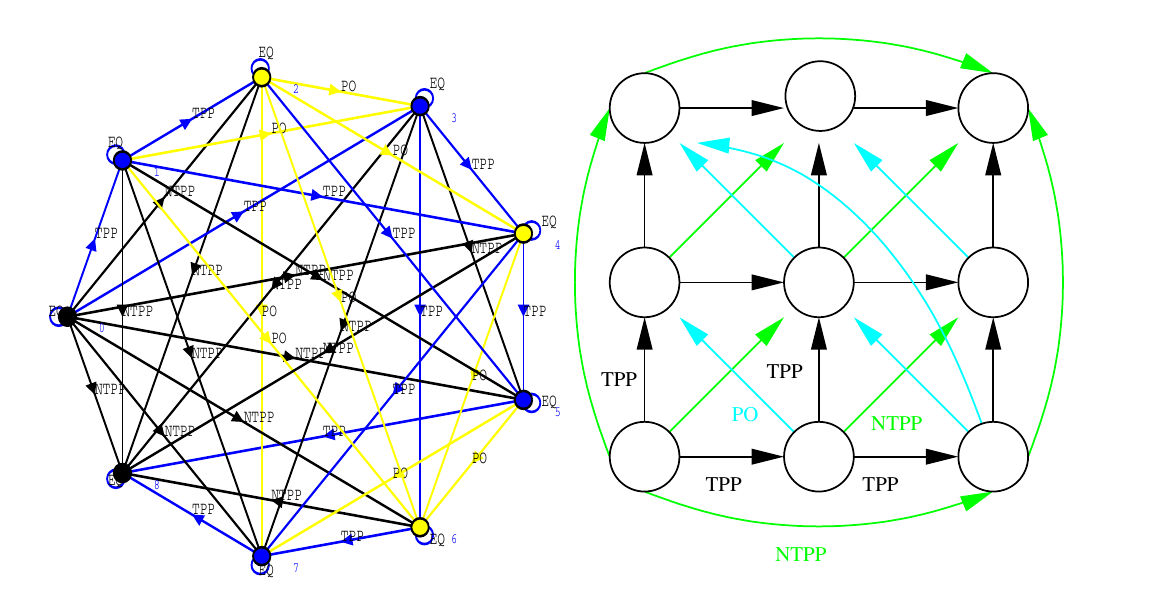
From my 2002/2003 report: an RCC8 network that is isomorphic to a 3x3 grid. Such grid models exist, but no concept is known that forces one - that gap is why the problem is so hard.
My main point, though, was a warning: agentic AI was about to change how mathematics is done, and the description logic community should get ready for it. I made that point in an extended abstract for the Description Logic Workshop DL 2026, "Description Logic Research in the Era of Agentic AI: The World's First AI-Generated Description Logic Decidability Proof?", around a candidate decidability proof written by AI. It was rejected in May 2026, after the DL Steering Committee had been consulted. In my view, none of the three reviews engaged with the warning; their technical objections were about the optional appendix. To be fair: the candidate proof for the full logic did not survive our own later reviews either, and my open letter concedes that one sentence claimed too much. The submission, the reviews and my open letter to the committee are public. Two weeks later, on June 2, 2026, the Leiden Declaration on Artificial Intelligence and Mathematics was published, and the International Mathematical Union endorsed it: mathematicians warning that AI is challenging the core values of their field.
Where it stands (November 2026)
The full question is still open. Two fragments are decided, with decision procedures that the Lean 4 kernel checks end to end: the ∀PO-free fragment (August 2026), and a modest extension that allows ∀PO. Both are decidable but not runnable - the search spaces are far too large. And we now know where the problem sits: two-variable logic over strict partial orders, whose decidability is an open problem at the frontier of logic research, embeds into ALCI_RCC5 (also checked in Lean). So ALCI_RCC5 contains an open problem of two-variable logic. I wrote to the researchers who work on it in an open letter. No human expert has verified this work yet.
Meanwhile
In the same months, AI took on the most famous problems in mathematics. In September 2026, OpenAI announced a proof, with a Lean formalization, that the Navier-Stokes equations with a smooth external force can blow up in finite time - one variant of the Millennium Prize problem; a later paper questioned whether the Lean version says the same as the written proof. In October it announced a proof of a weaker form of the Riemann hypothesis. And in November 2026, Levent Alpöge announced a proof of the Riemann hypothesis itself, found with Claude and checked in Lean; the Lean FRO and the Mathlib Initiative endorsed it the next day, and a proof that humans can read is still to come. ALCI_RCC5 is still open - but we now know where it sits, and two fragments are decided.